01 / Maps & walking
The useful quiet
of a small map
A map leaves most of the world out. That can be a good place to begin paying attention.
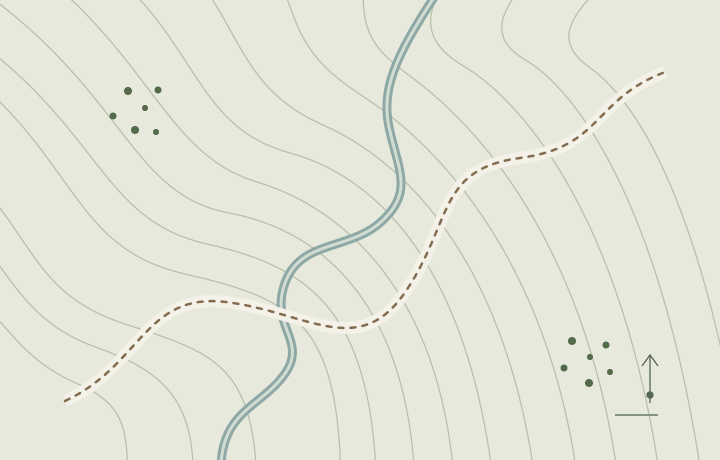
A small paper map is full of useful omissions. It has room for a path, a patch of woodland, perhaps the shape of a hill. It has no room for the smell of wet leaves, the gate that closes with a hollow ring, or the place where the afternoon light catches the grass. Those things have to be found on foot.
This is part of its appeal. The map offers a structure without filling in the whole experience. A thin line says that a way through exists. It does not say how long you will want to stand beside the stream.
Read the spaces, too
Before setting off, it is tempting to follow the intended route with a finger from start to finish. Try looking beside it as well. Where does the ground rise? Where does the water gather? Which paths follow the edge of a wood rather than crossing its middle? Even an ordinary loop begins to have a shape beyond its distance.
Then fold the map so that the part you need is easy to see. The entire sheet need not accompany every decision. A nearby junction and one clear landmark are often more useful than a view of the whole afternoon.
The line is a suggestion of a walk.
The walk supplies the rest.
Let the ground answer
Out on the path, compare the marks with what is in front of you. A tight group of contour lines becomes a slope felt in the legs. A narrow blue stroke becomes water moving under a bridge. The small translation from symbol to place is quietly satisfying.
A map can also be old, incomplete, or simply hard to read. A closed gate is still a closed gate, whatever the line on the page suggests. Respect signs and access boundaries, allow time to turn back, and choose a walk that suits the conditions. Curiosity works best with a little margin.
At the end, unfold the sheet again. The route is the same thin line it was before. But now a few places on it carry a sound, a colour, or a pause. The map has not changed. Your reading of it has.